
Why do we do what we do? Hacking humanity the Silicon Valley way

In my first post I talked about Donald Trump’s popularity, focusing on his support by billionaires. Rather than taxes or regulations, wokeness or “free speech,” I looked at something else: the trend to an authoritarianism with racialist overtones (or perhaps, racism with authoritarian overtones) in the discourse of Silicon Valley. This post will be the second in a series about this issue.
Silicon Valley’s early years were influenced by counterculture movements of the 1970s. Steve Jobs and Steven Wozniak, co-founders of Apple Computer, are perhaps the most famous proponents of the idea that computer technology could enhance creativity and freedom. The original Apple Macintosh was released in 1984 with the tagline “a computer for the rest of us,” tying the brand not merely to graphical user interfaces and mice, but to an ethos where technology could be beneficial not just to corporations and governments, but to the individual. Jobs and Wozniak mark the combination of two countercultural trends, with Wozniak influenced by the early tech libertarian group, the Homebrew Computer Club, and Jobs devoted to the more spiritual and alternative aspects of the counterculture.
The emergence of the Internet in the 1990s only expanded this countercultural optimism. Howard Rheingold, whose The Virtual Community (1993) explored the likely benefits of online networks, brought network theory into “cyberspace.” Rheingold argued that the Internet could lead to new avenues for both sexual exploration and political activism, two topics that were key to the 1960s counterculture. Douglas Rushkoff was initially another idealist, utilizing ideas from McLuhan and Neil Postman in putting forth a techno-utopian vision of society. This coming digital society would create new forms of community and socio-political expression, taking power out of the hands of traditional gatekeepers and allowing for the formation of emergent communities.
While this ‘90s discourse proved to be correct in the particulars, anyone reading this is aware that the optimism was, at best, misplaced. What changed and why? There are almost innumerable explanations. The entire military and ideological apparatus of the US was focused for four years on 9/11; the fear, trauma, and hatred generated during this era had to go somewhere. The “capitalism no longer works” economic collapse the ended the Bush years was another epoch-shattering Black Swan event that, to most, seemed to blow over with a whimper. The niche communities, promoted so optimistically by tech and media theorists in the ‘90s, turned out to be dystopian, racist and sexist hellscapes; the utopian possibilities of the Internet seem more distant than ever.
While not denigrating these, or other explanations, my work as a Communication scholar has led me down a different path. What motivates human behavior? In other words, why do we do what we do? Democracy is based upon a political philosophy that assumes a rational subject – a person who can, and is willing to, learn things upon which to base rational decisions. The economic system of capitalism – at least in microeconomics – is similarly based on a rational subject, who thoughtfully decides on purchases by weighing needs and desires against individual finances.[1]
The problem is that at least since Freud, the social sciences have moved away from the rational subject. Behaviorism – a profound influence on advertising and marketing – eliminates “rationality” altogether from a “decision-making” that is now a complete misnomer. Cognitive psychology has brought reason back, to an extent, but only as a gestalt of an incredibly complex system of perception, memory, and awareness, all of which lies at least partly outside of conscious control. There are contemporary philosophers and psychologists –who influence AI and tech culture – who believe most strongly that what we think of as consciousness is an illusion, a meaningless byproduct of other systems.
Many of my readers probably remember Cambridge Analytica (CA): the British political consulting firm that stole user data from Facebook in the effort to elect Trump in 2016. CA posted one of those time-killing, at-one-time extremely popular quizzes on Facebook: “This Is Your Digital Life.” In taking the quiz, CA was “granted permission” to use not simply all of your personal data – likes, personal posts, brand engagement, marketing profiles – but that of your friends as well. CA made customized political messages based on this information, which they claimed were extraordinarily effective.
My point is not whether this worked to get Trump elected; “why do we do what we do” is an almost impossible question to answer for any individual decision. How many victims of CA changed their vote based on the content they were given? Like anyone can even know that.
My point is that while the US government, regulating bodies, journalists, academics, and privacy NPOs bloviated against CA, everyone in tech took a different lesson. How could the optimistic, 70s counterculture vision of radical sexual and political freedom survive the fact that people, at the level of group identity, have been hacked? The “sexual freedom” of the ‘70s has become the “hentai porn” of Pornhub (their most popular category). The “political freedom” promoted by the ‘60s radicals (and, for that matter, the Gen Xers) has become an intensely bifurcated system where politics equals identity, where “Trump voter” or “Harris voter” is as fundamental to your subjectivity as race, gender, and class.
This is not meant as a criticism of intense voters on either side. If you feel (rightfully) that Trump will harm women’s health and LGBTQ+ rights, it’s logical to focus on this. I assume similar arguments could be made against Harris, likely concerning economic and cultural displacement that the mainstream Left either ignores or offers band-aid solutions.[2]
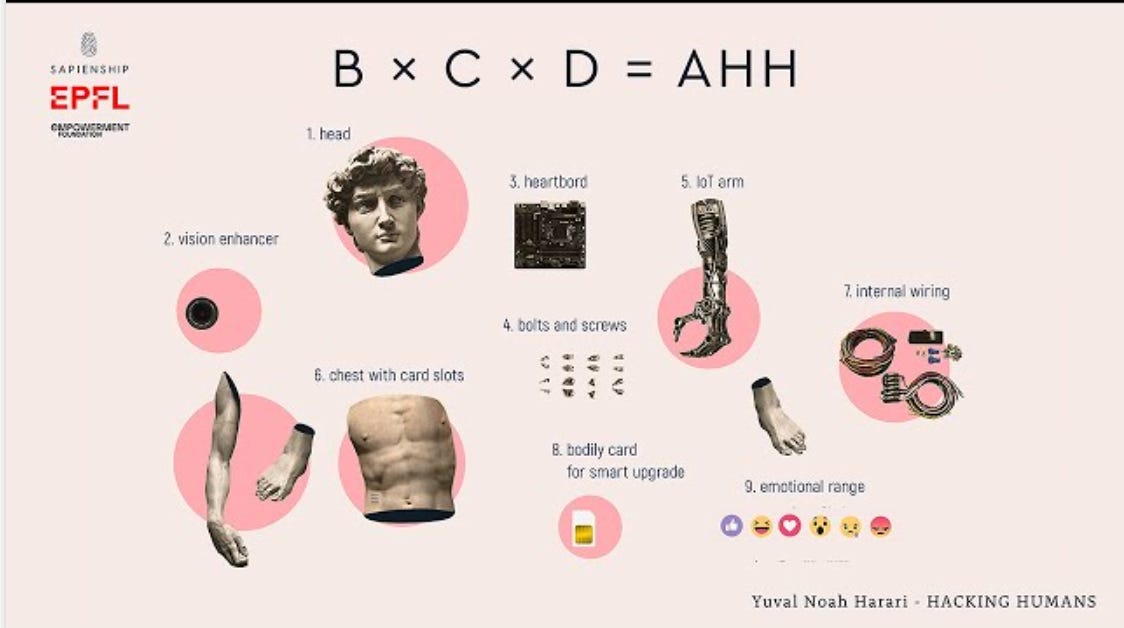
Instead, I write to pull back the curtain on Silicon Valley ideology. They have realized that Big Data, run through personality types and self-learning AI systems, can create incredibly detailed profiles of individuals and groups. It’s behaviorism at the largest scale – people will literally tell tech companies, for free, what they like, and this information can be used to sell them whatever nonsense product and scam artist that billionaires will pay for.
We are sheep to them at best. If you are a billionaire, and you genuinely believe this, are you going to support the candidate who agrees with you? A narcissist who uses people to feed his own delusions about his superiority, just like you? Or will you support the candidate who comes at this job from a different perspective, weighing decisions based on the genuine needs of individuals and groups?
There is far more to this story and I will continue in later posts: the hippie-to-Q pipeline. The absurd power of trolling. The way the implementation of biopower has increasingly regulated our lives. But most importantly: the way all of these seemingly unrelated things, and more, feed the intense racism, sexism, and overall misanthropy of the new Nazism of America and its tech oligarchs.
[1] I am aware that this greatly simplifies microeconomics; for example, recent concepts deal extensively with uncertainty and irrational behavior. The 2008 crisis was possibly the death knell of the “rational economic man”…in theory. If the system is partly based on this concept, however, twenty years of theory cannot undo the damage.
[2] My criticism of the Left does not negate my commitment to vote Democratic in 2024. If we cannot criticize the blind spots of the party, we might as well throw MAGA hats on. However, if we engage in online criticism in lieu of voting, MAGA hats might soon be attached to our heads (and genitals) by Presidential edict.
[3] The fact that China’s economy has (comparatively) tanked is conveniently ignored. Perhaps this is reasonable, since no doubt China will recover. But in other areas, short-term blips are often taken as grand failures - another analogy stolen from sports, no doubt. No such discourse has been forthcoming about China. This is interesting because, with China and the EU both going through downturns, the US has the fastest growing large economy in the world. However, the idea that the US, at this particular moment, has no serious macro-economic competitors is anathema to both parties.